
When I went to my first TweetUp a couple of years ago in Westchester County, the speaker was David Mathison, who wrote Be the Media, which details how each of us has the opportunity to communicate directly with audiences known and unknown, without being filtered by traditional forms of radio, television, newspapers and magazines. I was intrigued by his talk, purchased the book, and have used the phrase "be the media" often in my classes.
When an item is posted on twitter, Facebook, LinkedIn, Google+, or other social media, we can directly reach our followers, friends, connections or circles. When a photo of the completed Route 9 pedestrian walkway was posted on Marist's Facebook page, it made 17,555 impressions and generated 155 likes and 37 comments, nearly all of them positive. The vast majority of the nearly 8,000 people who "like" the Marist page are current students, alumni, prospective students and their families, elected officials, and the college's faculty and staff. The page reaches those important constituencies directly to engage conversation, foster reminiscences, inform, and persuade. By now, I hope each person reading this blog understands this is how social media is supposed to function.
Let's see how one individual, a talented, young Marist alumnus, became his own "medium" to successfully raise money for a particular project. In turn, he gave back to his alma mater in a unique way.
Robert Vijay Gupta, graduated from Marist in 2005 at age 16 with a bachelor's degree in biology. He went on to get his master's degree in music from Yale in 2007. That year, he became the youngest violinist (at age 19) with the Los Angeles Philharmonic. Those in the music industry who do not want to be tied to a particular label fund their own projects through social media. I learned through a tweet from Robert that he was doing this for a CD of recordings, including one of his own compositions, that he will play on a 1716 Stradavarius violin:
guptaviolin87 so many thanks to everyone that's contributed to my @kickstarter album so far - only 5% to go! http://kck.st/jxkF0d
Kickstarter calls itself "the largest funding platform for creative projects in the world."
I promoted this on twitter and Marist's Facebook page. Among those who read the Facebook posting was Marist President Dennis Murray, who later got an email from Robert detailing the project. President Murray sent a contribution. Robert went over his $20,000 goal more than a week before his deadline, raising nearly $22,000 from 216 backers. I am not claiming credit for that and it would be difficult for me to prove any donations came from Marist's social media efforts on Robert's behalf, but I do know that the Facebook posting alone made 6,709 impressions and 11 people "liked" it. As a community, Marist is very proud of Robert's accomplishments and I was happy to publicize his efforts. As a thank you to President Murray and Marist, Robert played a selection from the CD at a Marist Welcome Reception for incoming members of the Class of 2015 on July 20, in Santa Monica, California.
Robert had fun with his fundraising. His incentives to donors ranged from two hi-res mp3s for a $5 donation to this premium for a donation of $10,000 or more: "A live 90-minute recital in Los Angeles or New York, and...I'll cook you dinner! My Mom's recipe for the *best* lamb curry you've ever tasted" (plus all of the items mentioned for lower levels of donations). While Robert did not get a $10,000 backer, he got two people to donate $2,500. He is now providing updates on the strenuous recording process, keeping his supporters engaged throughout the process. Bravissimo, Robert!
THAT is the power of social media.
One last thing...While I would have enjoyed Robert's private concert for incoming Marist freshmen and their families, and alumni who attended the reception in California, I was at another social media event in Boston on July 21. It was the first Marist Boston TweetUp, organized by 2004 Marist alumna Liz Swenton (@lizswenton on twitter), who is one of three Marist alumnae working at March Communications in Boston. Fifteen alumni and a Marist senior, Marissa DeAngelis (@MSDe526), about whom I've written in the past, attended. Three drove up from Rhode Island one drove in from Connecticut. It was a mixer at Back Bay Social Club (@BackBaySocial), with dinner, the exchange of business cards, the renewal of long-standing friendships and the forming of new ones. These were public relations and journalism majors, most of whom were my students. It gave me a chance to talk about developments at Marist and get updates on their careers. One attendee found she was interviewing at the company of another attendee, an opportune contact. Remember my post on networking? It works. We all enjoyed ourselves and I left with a tremendous sense of pride in these Marist grads. I look forward to similar TweetUps in other cities in the weeks and months ahead.
Friday, July 22, 2011


Tuesday, July 12, 2011
Tweeting Yourself Toward Employment
I'm grateful to Jenny Zou (@jiejennyzou on twitter) of the Chronicle of Higher Education for her very kind article about my efforts to help my students and other Marist grads find jobs via social media, specifically twitter. I will not rehash what Jenny wrote. You can read Jenny's post in a popular Chronicle blog called WiredCampus.
What I want to discuss here is how this piece came about because it's a lesson in media relations that in itself made news recently because of the issue of "access." First, let me tell you how this article appeared, then I'll mention the controversy surrounding a well-known freelancer for the New York Times and offer a few of my own thoughts. I would appreciate your feedback on this, too, because it is an issue I will discuss with my class next semester.
For 14 of the last 18 years I have attended the College Media Relations Conference, initially started by a gentleman named Art Ciervo, picked up by Keith Moore, and now run by the Council of Independent Colleges and the American Association of State Colleges and Universities. I've had the privilege of speaking at this conference on social media, and it is a wonderful opportunity to network, learn from my peers, and meet reporters from a wide variety of media who come to talk about their publications, blogs, and TV and radio shows. My friend Steve Smith (@RedCladLoon), who is the national news editor at the University of Nebraska at Lincoln, spoke this year on his work in social media and wrote a great blog entry highlighting the various talks at this year's conference.
At one of the sessions, higher ed media reps are given the opportunity to meet with reporters and editors from the Chronicle and InsideHigherEd. As I was heading into the session featuring about a half dozen Chronicle reporters, I bumped into Chronicle Editor Jeffrey Selingo (@jselingo). I have much respect for Jeff and appreciated his comments on my social media work at a PRSA Counselors to Higher Education conference last April. I mentioned to Jeff how one of my students, Alyssa Bronander (@ARBro), had sent me a tweet the day before saying she had not yet been hired. I couldn't understand why because Alyssa is exceedingly bright, knows social media, is an excellent writer, and extremely personable. So, I tweeted my incredulity with the hashtags #HireThisWoman and #HireArbro. In less than five minutes, Alyssa got a tweet from another of my former students, Rob Gedarovich (@rgedarov), whom I mentioned in a previous post, asking for a résumé. Alyssa eventually was hired by Toys R Us and just started this week as te corporation's associate social media manager.
I mentioned this off-the-cuff to Jeff and I honestly did not do it as a pitch. We were just talking. However, Jeff heard a good story, introduced me to Jeff Young (@jryoung), a top tech writer at the Chronicle and for the WiredCampus blog. Jeff assigned the story to Jenny, who spoke with me by phone as I rode Amtrak back to New York. Alyssa and my outstanding student intern this past year, Jim Urso (@JimUrso) also emailed and spoke to Jenny to round out the story. An aside...Jim starts soon in the media relations department at Hofstra University. My thanks to Karla Schuster (@KarlaSchuster) for hiring Jim. I know it's a cliché but it's true -- my loss truly is Karla's gain.
What's so controversial about this process? To me, nothing. However, to the public editor of the New York Times, you would think PR people were like all those corporations that, on their own or via highly-paid lobbyists (many of them former lawmakers) pay for access to politicians in Washington. I have met Times reporters at the College Media Conference every year, and was able to get a piece in a Times blog last year by pitching a reporter who had just completed his presentation.
This process of give-and-take between journalist and public relations professional is common practice and ethical. If you have a good relationship with a reporter -- pitching only those stories that are truly newsworthy, returning phone calls, not limiting yourself to being a "fair weather friend," and maintaining the highest standards of honesty and integrity -- you have a much better chance of getting coverage of your event, product, location, individual, or, in my case, college, than if you do not have a good relationship with that reporter. That's a PR 101 lesson, not "get(ting) too cozy with the P.R. professionals who strive to influence coverage," as the Times' public editor alleges. A journalist and a media relations pro must understand their roles. They are not mutually exclusive. They are similar -- tell a story that is worth people's time, enlightens them, and in some cases, advocates for the common good (though that last point is always open to interpretation).
In the back of my mind I think there must be another reason for the Times to go after David Pogue (@Pogue). Maybe, someday, the Times' PR person will tell us what it is.
Your thoughts?
One last thing...I'll let you in on a little secret. The second commenter at the end of the WiredCampus post, "mahoneypoststar," is Mark Mahoney, who was a student in a broadcast journalism class I taught at Dutchess Community College about 30 years ago. Mark was a gifted student with a great sense of humor and a way with words. He started out at my old radio stations, WEOK/WPDH in Poughkeepsie. Today, he is the editorial page editor of the Post Star in Glens Falls, NY. Two years ago, he won the Pulitzer Prize for editorial writing. To say I'm proud of him is a dramatic understatement. I offer my thanks to him and to so many of my former students for their words of support and gratitude and retweeting Jenny's WiredCampus post. Their faith, confidence and affection are deeply appreciated. The sense of fulfillment I receive from working with and mentoring them is one of the wonderful aspects of my job, particularly at a college like Marist that truly is a community, or as some say, a family.
What I want to discuss here is how this piece came about because it's a lesson in media relations that in itself made news recently because of the issue of "access." First, let me tell you how this article appeared, then I'll mention the controversy surrounding a well-known freelancer for the New York Times and offer a few of my own thoughts. I would appreciate your feedback on this, too, because it is an issue I will discuss with my class next semester.
For 14 of the last 18 years I have attended the College Media Relations Conference, initially started by a gentleman named Art Ciervo, picked up by Keith Moore, and now run by the Council of Independent Colleges and the American Association of State Colleges and Universities. I've had the privilege of speaking at this conference on social media, and it is a wonderful opportunity to network, learn from my peers, and meet reporters from a wide variety of media who come to talk about their publications, blogs, and TV and radio shows. My friend Steve Smith (@RedCladLoon), who is the national news editor at the University of Nebraska at Lincoln, spoke this year on his work in social media and wrote a great blog entry highlighting the various talks at this year's conference.
At one of the sessions, higher ed media reps are given the opportunity to meet with reporters and editors from the Chronicle and InsideHigherEd. As I was heading into the session featuring about a half dozen Chronicle reporters, I bumped into Chronicle Editor Jeffrey Selingo (@jselingo). I have much respect for Jeff and appreciated his comments on my social media work at a PRSA Counselors to Higher Education conference last April. I mentioned to Jeff how one of my students, Alyssa Bronander (@ARBro), had sent me a tweet the day before saying she had not yet been hired. I couldn't understand why because Alyssa is exceedingly bright, knows social media, is an excellent writer, and extremely personable. So, I tweeted my incredulity with the hashtags #HireThisWoman and #HireArbro. In less than five minutes, Alyssa got a tweet from another of my former students, Rob Gedarovich (@rgedarov), whom I mentioned in a previous post, asking for a résumé. Alyssa eventually was hired by Toys R Us and just started this week as te corporation's associate social media manager.
I mentioned this off-the-cuff to Jeff and I honestly did not do it as a pitch. We were just talking. However, Jeff heard a good story, introduced me to Jeff Young (@jryoung), a top tech writer at the Chronicle and for the WiredCampus blog. Jeff assigned the story to Jenny, who spoke with me by phone as I rode Amtrak back to New York. Alyssa and my outstanding student intern this past year, Jim Urso (@JimUrso) also emailed and spoke to Jenny to round out the story. An aside...Jim starts soon in the media relations department at Hofstra University. My thanks to Karla Schuster (@KarlaSchuster) for hiring Jim. I know it's a cliché but it's true -- my loss truly is Karla's gain.
What's so controversial about this process? To me, nothing. However, to the public editor of the New York Times, you would think PR people were like all those corporations that, on their own or via highly-paid lobbyists (many of them former lawmakers) pay for access to politicians in Washington. I have met Times reporters at the College Media Conference every year, and was able to get a piece in a Times blog last year by pitching a reporter who had just completed his presentation.
This process of give-and-take between journalist and public relations professional is common practice and ethical. If you have a good relationship with a reporter -- pitching only those stories that are truly newsworthy, returning phone calls, not limiting yourself to being a "fair weather friend," and maintaining the highest standards of honesty and integrity -- you have a much better chance of getting coverage of your event, product, location, individual, or, in my case, college, than if you do not have a good relationship with that reporter. That's a PR 101 lesson, not "get(ting) too cozy with the P.R. professionals who strive to influence coverage," as the Times' public editor alleges. A journalist and a media relations pro must understand their roles. They are not mutually exclusive. They are similar -- tell a story that is worth people's time, enlightens them, and in some cases, advocates for the common good (though that last point is always open to interpretation).
In the back of my mind I think there must be another reason for the Times to go after David Pogue (@Pogue). Maybe, someday, the Times' PR person will tell us what it is.
Your thoughts?
One last thing...I'll let you in on a little secret. The second commenter at the end of the WiredCampus post, "mahoneypoststar," is Mark Mahoney, who was a student in a broadcast journalism class I taught at Dutchess Community College about 30 years ago. Mark was a gifted student with a great sense of humor and a way with words. He started out at my old radio stations, WEOK/WPDH in Poughkeepsie. Today, he is the editorial page editor of the Post Star in Glens Falls, NY. Two years ago, he won the Pulitzer Prize for editorial writing. To say I'm proud of him is a dramatic understatement. I offer my thanks to him and to so many of my former students for their words of support and gratitude and retweeting Jenny's WiredCampus post. Their faith, confidence and affection are deeply appreciated. The sense of fulfillment I receive from working with and mentoring them is one of the wonderful aspects of my job, particularly at a college like Marist that truly is a community, or as some say, a family.
Friday, June 10, 2011
How the Catholic Hierarchy Can Learn from a Lay Community
As I started to write this, I was sailing from Kuşadasi, Turkey to Patmos, Greece with Fr. Richard LaMorte, the chaplain at Marist College, and students in my religious studies course “In the Footsteps of St. Paul.” If you read my previous post, you’re probably wondering, “How can you teach theology when your own religion calls you ‘morally disordered’ and fights against equal rights for you?” A revelation of sorts (ironic, since Patmos is where the evangelist John is believed to have written the Book of Revelation), came from a discussion I had with John Boss, a Marist junior whom I’ve come to know and respect over the past two years, with whom I’ve had many honest conversations.
John asked me about the difference between religion and faith. It is a great question and while John wanted my answer to help enlighten him, it was he who helped me reflect on who I am and where I am going in my life. My response centered on my personal belief that faith is a reason to believe in a particular set of principles, religious or not, in my case, based on the teaching of Jesus Christ. Religion, on the other hand, is humanity’s imperfect attempt to codify those beliefs into a set of rules to live by – the dos and don’ts of a particular religion. Human attempts at interpreting the Divine Will will always be flawed because we are imperfect beings. We try to understand the mind of God, but since we are obviously less than God, we cannot reach the perfection of knowledge embodied by a Divinity. Yet, groups of people try and form bonds based on a particular set of beliefs.
All through history we have seen abuses of power that occur when a particular religion says it possesses the truth and those outside that sect are “morally deficient,” which is what the Catholic Church says about anyone who is not a Catholic and says of Catholics who don’t walk in lockstep with every single tenet of the Church. It is that type of thinking by any religion that leads to wars, whether the Crusades, “the Troubles” in Northern Ireland, or terrorism in many forms that threatens our world today.
Faith and religion always played a role in my life. As a matter of fact, I once studied to be a Catholic priest, including two years at the North American College in Vatican City and the Pontifical Gregorian University in Rome, called, respectively, the West Point and the Harvard of the Catholic Church. That time in the seminary system exposed me to both tremendous good and unquestionable evil by people who claim to represent God. I worked with Mother Teresa’s Missionaries of Charity in a soup kitchen and shelter for homeless men, served as an officer and Chaplain Candidate in the U.S. Air Force Reserves, stationed with the 36th Tactical Fighter Wing in Bitburg, Germany, and made friends from throughout the States and from several countries.
I also experienced first-hand the psychological head games played by priests in charge of a man’s “formation,” a nice way of saying brain-washing. I won’t go into details here, after all, I need to keep some material for my book (which I’ll probably never get to write) – “Looking Through Stained Glass.” Today’s seminarians preparing for ordination need to remember that the faithful in the pews come from a wide variety of backgrounds – age, experience, education, financial status, culture, ethnicity, and sexual orientation. I see such rigidity in today’s Catholic seminarians and priests ordained in the last ten years that leads me to believe they will get what they probably want – a smaller, “purer” Church, but in no more sole possession of “the truth” than any other religion.
I am now flying from Rome to New York, at the end of our two-week study abroad course that took us to Greece, Turkey, Rome and Vatican City. The past two nights, I took the students to Trastevere, my favorite section of Rome, its equivalent of Greenwich Village. My favorite Church is there – Santa Maria in Trastevere, parts of which date to the 4th Century A.D., or the “Common Era.” With its luminous mosaics and Cosmatesque floors, it is a beautiful building, but its true beauty comes from the people who use it as their parish church – the Community of Sant’Egidio.
The Community of Sant’Egidio began in Rome in 1968, in the period following the Second Vatican Council. Today, it is a movement of laypeople and has more than 50,000 members dedicated to evangelization and charity in Rome and in more than 70 countries throughout the world. The Community of Sant’Egidio is a “Church public lay association.” The different communities, spread throughout the world, share the same spirituality and principles which characterize the way of Sant’Egidio: prayer, communicating the Gospel, solidarity with the poor, ecumenism, and dialogue. They quote Blessed Pope John XXIII, who called on the Church to be the “Church for all and particularly for the poor.”
Whenever I question my faith or whether I should stay in the Catholic Church, I get these little signs, sort of like Jesus saying “Hey, don’t give up on me! Yeah, I wish my followers really lived the spirit of my teaching, not the law I came to abolish, but they don’t listen to me. Hang around awhile longer, OK?” Such was the case the last two nights of our stay in Rome, when I attended Sant’Egidio’s Evening Prayer. Their services are lay-led, with beautiful singing (something for which many Catholic parishes are not known), and a sense of community that draws in everyone.
The first night, I attended with Father LaMorte, the second with Father LaMorte and John Boss. While I understood the liturgy and the Italian, John didn’t, but our experience was the same, a true sense of belonging to something bigger than who we are as individuals. At the beginning of the liturgy, a woman gave John the community’s prayer book so we could follow along, and at its conclusion, a man, probably in his late-20s (you don’t see many people under 60 in U.S. Catholic churches today, especially men), looked over at John and me, smiled, and wished us a “buona sera,” or good evening, with a smile that said, “You are welcome here.” The members of the community stayed in the Church and hugged, kissed, and talked for more than half an hour. Contrast that with something that happened in my home parish in Poughkeepsie recently. Four parishioners, all middle-aged and active in the parish, were talking while standing in the vestibule of the church – not in the sanctuary, where the community was communicating at Santa Maria in Trastevere – and were scolded with a “Shush!” by a priest younger than all of us who was ordained about three years ago.
The first night, I attended with Father LaMorte, the second with Father LaMorte and John Boss. While I understood the liturgy and the Italian, John didn’t, but our experience was the same, a true sense of belonging to something bigger than who we are as individuals. At the beginning of the liturgy, a woman gave John the community’s prayer book so we could follow along, and at its conclusion, a man, probably in his late-20s (you don’t see many people under 60 in U.S. Catholic churches today, especially men), looked over at John and me, smiled, and wished us a “buona sera,” or good evening, with a smile that said, “You are welcome here.” The members of the community stayed in the Church and hugged, kissed, and talked for more than half an hour. Contrast that with something that happened in my home parish in Poughkeepsie recently. Four parishioners, all middle-aged and active in the parish, were talking while standing in the vestibule of the church – not in the sanctuary, where the community was communicating at Santa Maria in Trastevere – and were scolded with a “Shush!” by a priest younger than all of us who was ordained about three years ago.
I picked up a prayer card in the back of Santa Maria in Trastevere. It contained a photo that epitomizes the spirit of the Sant’Egidio Community. The pews were removed (they are not permanently affixed in these ancient churches) and tables were set up to serve lunch to Rome’s hungry at Christmas. They came to the church to be fed – physically and spiritually. Isn’t that what religion is supposed to be about? For Christians, isn’t that was Jesus asked us to? Thirty to forty years ago, that’s what the Church did through its social ministry, fighting for equal rights for women, African Americans, Latinos and Latinas, working men and women, and expressing a “preferential option for the poor,” woefully out-of-fashion in the Church and in our country in 2011.
If it weren’t for the pastor of St. Martin dePorres, Msgr. Jim Sullivan, I probably would no longer be a member of any parish (unless I felt like commuting to St. Francis Xavier on 16th Street in Manhattan, like I did for a few years in the 90s). He is what priesthood is all about – honestly prayerful, leading through humility, accepting (not just “tolerating”) others, humorous and capable of delivering a serious message through great homilies or simple actions from which the newly ordained can learn much. We are blessed to have him.
This is a long entry, so I will wrap it up and fill you in later on what our class did during our two weeks abroad.
One last thing…props to Delta Airlines. Their music selection for June includes “Delta Pride,” with this description “Party in the Sky celebrates Pride. Delta is proud to be an official sponsor of Pride celebrations in Atlanta, New York City, and the Twin Cities of Minneapolis and St. Paul.” My message to Delta: I’m proud to be a Sliver Medallion frequent flyer on your airline.
Thursday, May 19, 2011
Coming Out for Equality and Against Bigotry
Over the last couple of weeks, I have listened to leaders of the Catholic Church, my church, denigrate the dignity of gay and lesbian couples. Their denunciations are couched in terms like, “love the sinner, hate the sin,” or the Church will lay claim to victimhood due to “attacks” that some of its leaders, clergy and lay, are called bigots and homophobes.
I originally was going to submit this post last month following a vitriolic unsigned editorial in all likelihood penned, or minimally, approved by Bishop Thomas Tobin of the Diocese of Providence, RI, which appeared in the diocesan newspaper Rhode Island Catholic, ironically, on Divine Mercy Sunday. When it comes to gays and lesbians, divine mercy is an oxymoron to Tobin. The stunningly anti-gay editorial uses the politically charged terms “the radical homosexual lobby,” “so-called ‘equality,’ ” “homosexual activists,” “activists’ (sic) judges," “traditional marriage,” and “passing a Defense of Marriage Bill.”
A week ago, I attended a panel discussion at the United Nations on “The Dignity of the Human Person” celebrating the beatification (one step from sainthood) of Pope John Paul II. That evening, I tweeted, “Would love to ask if that includes #lgbt folk.” By the end of the event, I got my answer: NO! The last speaker, Douglas Farrow, professor of Christian Thought at Montreal’s McGill University, told the audience he had been asked by the event’s Vatican sponsors to focus on “marriage and attacks on the family.” He started by saying, “Human dignity is rooted in marriage and the family.” He went on to explain how that dignity cannot be granted to gays and lesbians living in committed relationships. Farrow went so far as to twist the great UN Universal Declaration of Human Rights, developed by one of my idols, Eleanor Roosevelt, by saying those rights do not extend to marriage equality for gays and lesbians for all of the “human history,” procreation,” etc. arguments we had heard ad infinitum.
Then, in this unholy trinity of attacks, I read a tweet last Friday by the excellent NY Daily News blogger Celeste Katz (@DNDailyPolitics) that New York Archbishop Timothy Dolan believes “Legalizing Gay Marriage Could Make "1984" Non-Fiction Reading, including the offensive canard that legalizing same-sex unions and providing the same protections granted to opposite-sex couples will lead to the slippery slope of being “morphed again to include multiple spouses or even family members.” I will give Dolan credit for not including family pets and inanimate objects in those possible unions, something other so-called religious and political leaders have claimed. Dolan’s comments led one of my twitter followers, Nick Fugitt (@nfugitt) to respond: "Telling people who they can and can't marry is...NOT like 1984? #cuethecircusmusic."
All these attacks come as the New York State Legislature moves closer to a vote on marriage equality. There is no doubt this human rights law will pass the State Assembly and would be signed by Governor Andrew Cuomo if the State Senate reverses its 2009 vote that saw the bill lose by 14 votes. My own state senator, Steve Saland, promised me he would vote in favor, but when he saw no Republicans would vote “aye,” he caved and voted “no.” Saland later told me he feared being primaried – despite the fact he had served in Albany, at that time, for 30 years. He also told me it was the worst vote of his career and that someday the law would pass. Senator, that someday could be in June 2011 if you become a “profile in courage” and vote yes for equality.
I'm normally an optimist and I hope and pray that a marriage equality bill will become New York law, but earlier today, Republican state senators from Binghamton and Brooklyn joined notorious anti-gay Pentecostal minister and Democratic State Senator Ruben Diaz to introduce an incredibly mean-spirited bill to invalidate out-of-state same-sex marriages in an attempt to curry favor with the state’s Conservative Party, which threatened to withhold its endorsement from any GOP senator who votes for marriage equality. I am also a realist and know there are not enough votes to repeal DOMA, the true barrier to full equality nationwide.
How can anyone say that my relationship of 30+ years with Pete is of no value? How can any politician vote to deny legal recognition of a partnership that has lasted longer than a majority of heterosexual marriages? How can a religious leader say we should not be afforded the human dignity allowed straight couples who were married for 55 hours (like Britney Spears) or Catholic presidential candidate Newt Gingrich, who believes so much in the sanctity of marriage that he has had three of them, the last two following adulterous affairs.
As I started writing this post last Saturday, Pete was lovingly caring for his 94-year-old mother, cleaning her then dressing her before driving her to New Jersey to get her hair cut by the woman who has been doing that job for 30 years. Being a caregiver is a full-time job, yet that’s not all Pete does. He also sells real estate following a layoff 16 months ago that ended a 32-year radio career. It’s not easy and his modesty will not allow me to detail the difficulties he has performing all the tasks necessary for being a caregiver, but everyone who knows Pete confirms what I have long known – he is the warmest, most caring, deeply loving, selfless person anyone ever meets. Meeting him was a gift from God. Being partnered with him for this long, and for hopefully at least another 30+ years (God willing), has been a blessing.
I’m proud and honored to be an “adopted dad.” Pete and I serve as mentors to young men and women in college and in careers. We are actively involved in our community, pay our taxes, keep up our home, help our neighbors, and contribute what we can to a wide variety of nonprofits and causes. I am heartened by the changing attitude of Americans of all ages, but particularly among those under 30, and religious leaders of many denominations, including those Christians who ask “What Would Jesus Do?” and respond by being welcoming and accepting of all.
God forbid, if something were to happen to me tomorrow, Pete and our moms would lose the house we have lived in for the past 12 years, thanks to estate taxes that Pete would be forced to pay because there is no right to inheritance for lgbt couples. He will not get my Social Security benefits, unlike my mother who received my father’s benefits after his death in 1999, nor would he get the measly $255 death benefit granted by Social Security. While I am grateful that Marist College offers domestic partner benefits, I must pay several thousand dollars in state and federal taxes on the 85 percent contribution made by my employer, something that legally married couples do not have to do. At least we were born in the U.S. If one of us were a foreign national, we could face deportation. There are more than 1,400 federal and New York State laws that protect married couples, protections denied to Pete and me and millions of other lgbt couples, because of the so-called Defense of Marriage Act and the failure of the New York State Senate to offer equal protection under the law.
Is this what the Catholic Church and elected officials really want – forcing surviving family members, including two nonagenarians, out of their home? Do they really want to put roadblocks in the way of affording healthcare? Do they really want to split families? Do they really enjoy inflicting pain and suffering? Doesn’t sound very “Christian” to me. Catholic leaders say their religious liberty is being infringed upon. I have two answers to that. First, the Catholic hierarchy is infringing upon the religious liberty of denominations like the Episcopal Diocese of New York, which supports marriage equality. Second, the Catholic hierarchy’s religious liberty should not trump (pardon the use of that term/name) Pete’s civil liberties and mine for equal protection under the law.
I know there is a lot of money to be made from homophobia and bigotry. Those evils put cash and checks in collection plates, business reply envelopes from organizations like the National Organization for Marriage and the American Family Association, and candidates’ coffers.
If there is a “Last Judgment,” I believe those who preach hate and stand in the way of equality for the lgbt community will be asked the question posed by Jesus to Saul on the road to Damascus at the time of his conversion: “Why are you persecuting me?” (Acts 9:4). For “whatsoever you do to the least of my brothers (and sisters), that you do unto me,” (Matthew 25:40).
Pete and I hope that by the time of our 31st anniversary in October we will have civil recognition of our relationship in the eyes of the state. We already have that recognition in the eyes of God.
One last thing…I was saddened to see in my own parish bulletin last weekend two pages on “Why Marriage Should Not Be Redefined,” provided by the "Family Life" Office of the Archdiocese of New York. It contained the same tired, disproven accusations about the collapse of human civilization because of “homosexuals” (a “tested” word that sounds much more ominous and “other” than saying “gays and lesbians”). It also contains a “reassuring” paragraph telling the faithful that this is proper discrimination, or as the Archdiocese of New York phrased it using a double-negative, “It is not improper ‘discrimination’ to treat same-sex relationships differently from marriage…” This is the type of cultural relativism decried by the Church itself by no less than Pope Benedict XVI, but it is apparently justified by the Church against gays and lesbians. The “Good News” is that New York is turning away from the discrimination promulgated by the Catholic Church. Even though I am Catholic, I must remind Church leaders that Catholicism is a minority religion in the U.S. In addition to the bold support from the Episcopal Diocese mentioned above, more than 700 religious leaders from around the state recently restated their support of marriage equality. If the Church argues that a “minority” population of gays and lesbians should not be allowed to change the definition of marriage, the Church must remember that they, too, are in the minority and should not bar people of any faith, or no faith at all, from a civil marriage.
Thanks to my beloved adopted son Luke (@LShane262) for giving me the name for this entry and for his support and encouragement to post what he calls "a rant, but a necessary one."
Sunday, May 8, 2011
Networking for Fun and Profit
Networking is how you will get a job. My students hear me say this a dozen times a semester. That’s why I bring successful former students of mine back to the Marist campus to talk about how they got their first job, progressed into the position they have today, and get noticed for their accomplishments. Those alumni and alumnae, in turn, offer their help to review resumes and cover letters, provide advice on how to conduct the job search from application to interview to acceptance, and generate leads on openings in their own organizations or at other companies.
The Marist network is very strong in many fields. It’s not just communication; it’s information technology and computer science, teaching, criminal justice, finance and business administration. Many alums have signed on to be part of the Marist Alumni Career Network, a great resource for students getting ready to graduate and alums who are looking to move up or move into a new field. Generally speaking, Marist students enjoy their four years at the college, learn, work substantive internships, make many friends, and have a good time. All of those activities go far in preparing someone for the work world.
I also take my students to Manhattan every semester to see Marist grads at their places of work. This year, we visited Kaplow (@kaplowpr), where Robert Gedarovich (@rgedarov) is supervising digital & media strategist for technology & consumer practice (nice title). Among his accounts is Foursquare (@foursquare). We also visited David Heinzinger (@dvyhnz), senior account manager at G.S. Schwartz. Bob and Dave have made names for themselves in the use of social media in public relations. Their roads to where they are today serve as an inspiration to current students, many of whom fret they won’t find a job, particularly in this down economy. Positions, especially entry-level, are opening again, and as part of that Marist network, I often get job leads from my former students or from Marist grads whom I’ve gotten to know through twitter, facebook, LinkedIn, or other social media platforms.
How else can a prospective public relations pro network? If a student is not a member of PRSSA (@PRSSANational), s/he should be. There are workshops, conferences, and other events, some of which have minimal cost. Attend them, mix and mingle, introduce yourself, and exchange business cards. More and more students are printing their own business cards, which are a great, inexpensive investment. No matter how technologically advanced we become, the business card will always be around.
The social media platforms I mentioned earlier are also networking opportunities. If you’re a public relations major, I invite you to go through my twitter lists, especially PR and SocialMedia. There are many pros on those lists, people who may someday be a potential employer. Follow them and create a conversation with them.
Participate in twitter chats. There are many, but two I recommend in particular are #journchat (Mondays from 8 to 10 p.m. ET) and #prstudchat, held monthly but with frequent hashtag posts daily. Both are a mix of journalists, public relations practitioners, and current students. You can also joined their LinkedIn groups – for #journchat: http://linkd.in/lytBeM; and for #prstudchat: http://linkd.in/kDuSSo. Search for other groups on LinkedIn that represent your interests and participate in those discussions.
There are twitter chats on a wide variety of personal and professional interests. My "adopted son," Luke Shane (@LShane262), is a phenomenal marathon runner. I've watched him in the Philadelphia Marathon, where he finished 53rd out of almost 9,000 runners in 2:42:52, and the Boston Marathon, where he finished 341st out of nearly 30,000 runners, despite running on no fuel thanks to an errant fire alarm in our hotel at 5 a.m. marathon morning. He has been networking in the running world, has some very well-known marathoners following him, and participated in his first #runchat tonight. Luke had many of his points retweeted and he picked up more than a dozen followers because he knew what he was talking about and he knows how to create and encourage conversations via social media. Luke's blog, Witness the Fitness, was an inspiration for me to start "Looking Through Stained Glass."
There are twitter chats on a wide variety of personal and professional interests. My "adopted son," Luke Shane (@LShane262), is a phenomenal marathon runner. I've watched him in the Philadelphia Marathon, where he finished 53rd out of almost 9,000 runners in 2:42:52, and the Boston Marathon, where he finished 341st out of nearly 30,000 runners, despite running on no fuel thanks to an errant fire alarm in our hotel at 5 a.m. marathon morning. He has been networking in the running world, has some very well-known marathoners following him, and participated in his first #runchat tonight. Luke had many of his points retweeted and he picked up more than a dozen followers because he knew what he was talking about and he knows how to create and encourage conversations via social media. Luke's blog, Witness the Fitness, was an inspiration for me to start "Looking Through Stained Glass."
Follow blogs and offer your informed opinion. There are many, but among those I recommend are RepMan, PR at Sunrise, The Bad Pitch Blog, PR 2.0, Euro RSCB Blog, and The Flack (although I despise that term). Read posts and comment – but use your real name. Many of these blog writers are partners or other senior members of firms. If you are on their wavelength, or even if you’re not but can defend your point of view, you will get noticed. If there is an opening, you could be contacted by the blogger, or you can apply and be a familiar name to the person who will make the hire. Prove your value, your knowledge, your ability to think strategically. These are qualities sought by employers.
The days of applying for a job via a newspaper “want ad” are over, and you may be surprised that the offer that comes from a Monster.com posting is a glorified boiler room cold calling operation. You have a better chance of getting that first job by making contacts and becoming known. You will still have to prove you have the skills and character traits to earn that job. Once you get it, work hard, do more than is required, get noticed for your successes, and future offerings will come to you. PR is a small community. My students marvel at how intertwined individuals are. Co-workers today may be competitors tomorrow, and vice versa. Who knows how someone you meet today can help you down the line, or how you can help him or her.
One last thing…what a week I had! It was exceedingly busy and will be for the remaining fortnight of the semester, so there goes the idea of posting at least three times a week. Alex Shippee (@AlexShippee34) graduated from Marist a year ago and is someone whom I greatly respect and deeply admire. I don’t know too many 20-somethings who read Dante for pleasure. Alex does. He is well read, an outstanding writer, and best of all, a wonderful person. When he gives me advice, I listen. I asked Alex for feedback on my first few posts and I hope he doesn’t mind me telling you what he said:
“High quality content goes a long way. I was blown away by your ambition to post 3 times a week (!) and definitely wish you luck, but you know better than I that blog content sits a while. Weak posts can do more damage than a period of silence. If you're ever unsure about a particular post, let it sit in 'drafts' while you think about it. Knowing you, you'll have another great story before too long, especially if your first three blogs are any indication.”
Excellent suggestion, Alex. I’m still learning, too and I appreciate your help. You can follow Alex’s blog at http://alexshippee.blogspot.com/
Saturday, April 30, 2011
How to Stand Out from the Crowd and Get the Job You Deserve
Over the course of a year, about 100 students ask me to help them with their cover letters and resumes and I am happy to do so. With the help of my colleague Leslie Bates, editor for college advancement and proofreader par excellence, we look for content, style and grammar. With a little over three weeks until Commencement, this would be a good time to briefly review what makes a candidate stand out among the stiff competition for jobs in a hurting economy. These same rules hold true if you’re applying for an internship.
Too many applicants focus on themselves in their materials. I tell students, “Employers don’t care about you,” which makes them pay attention. What they care about is, “What are you going to do for them?” Keep the focus on your prospective employer and relate how your skills will help her or him.
Start doing that in your cover letter. I can tell more about a job applicant from the cover letter than from a resume. Your cover letter reflects your writing skills, personality, marketing and public relations efforts, and your ability to think strategically. Sell yourself from the first sentence. Nearly every cover letter starts off with a phrase similar to, “I am applying for a job in X,” or “Please consider me for Y position with your company.” BLAH! Stand out from the crowd! You have to impress the person who may hire you – 10 seconds. Don’t waste a single word or line of that letter.
Perhaps you had an experience that is in keeping with the ethos of the organization. In 2006, one of my students, Amber Sisson, attended a Rally for Darfur in Washington, DC. She saw a table for Amnesty International and picked up some information about their work, including a notice on the availability of internships in Amnesty’s Manhattan office. Amber started her cover letter with a story about herself – interest in human rights and her attendance at that rally. She then connected her personal interest to the work of Amnesty and detailed how the skills she learned studying communication at Marist would be put to work as a public relations intern. Amber got the internship.
Megan Murphy, like Amber, a 2007 Marist alumna, wanted to intern with the Hudson Valley office of United States Senator Chuck Schumer. That job was run out of the Valley representative’s home. Megan did her research on the person who had the job – a Red Hook town board member – and related her thoughts on the balance necessary to represent a senator while serving as a local elected official and how her writing, speaking and organizational skills could help. Megan got the internship and today is Senator Schumer’s scheduler.
Reflect on who you are and relate those qualities to the needs of the company or division to which you are applying. Impress with your accomplishments, but only insofar as you can explain how what you’ve done fits in with the needs of the company or agency. Are you an Eagle Scout? Don’t be afraid to mention that because the qualities necessary for that achievement translate well into one’s work and personal life. Are you a marathon runner who has placed well? Mention that because the discipline required to be an elite runner bodes well for a prospective employee’s work habits.
Did you have a substantive internship? Provide information and be a specific as possible. A student who came to see me the other day had a 3.98 grade point average but no work experience. He told me that he thought all you needed to do is work hard in college and have a high GPA. As impressive as graduating summa cum laude is, he will be at a competitive disadvantage looking for work because he does not have one day of practical experience, while his competition has had one, two, three, even four internships – worth more than a year of work experience. A common question I hear from graduating seniors is, “An entry-level job is looking for a year or two of experience? How can I get that experience if I’m not given the opportunity to get an entry-level job?” The preferable answer is a “real” internship, that is, one where you are doing more than making copies and getting people coffee. You should be able to show great work products in a portfolio.
Use power words in your résumé and cover letter. A good list can be found here: http://bit.ly/mbk0Es. Complex vocabulary is not paramount and be wary of too many adjectives. Be confident without being cocky. A little humility goes a long way. At the end of your cover letter, close the deal. Tell the person reviewing your material what to do next. "Review my résumé." "I look forward to detailing my qualifications for and interest in this position." Make sure you give your email address and phone number, even though it's on your résumé. Stand out from the crowd with good (and error-free) writing and relate to your employer, and you stand a good chance of being called for an interview.
My next post will focus on the value of networking. The days of want ads are long over.
One last thing…I had hoped to add a post per day, but my schedule, especially this past week, kept me in meeting after meeting, which meant I couldn’t do my writing for work until after 5 or 6 p.m., often continuing until 10 or 11 p.m. By then, I’m exhausted, though you’ll still find me posting on twitter or Facebook until the wee hours of the morning. I will do my best to post at least three days a week during the school year, perhaps more frequently during the still-busy but slightly-less-hectic summer. While I have many topics in mind for the next several weeks, if you have suggestions for areas you would like me to address, please feel free to comment or send me an email at timmian.massie@marist.edu.
Tuesday, April 26, 2011
Just Another #MaristMonday
I don’t like being called a “social media expert” because I don’t believe there is such a thing. The social media evolution, or should I say revolution, makes it nearly impossible to keep up with every new networking or bookmarking site. Last June, when I spoke at the College Media Conference in Baltimore, MD, I mentioned a Web site called namechk.com. It listed 149 such sites which you can check to see if your user name or “vanity URL” is still available. Fast forward to earlier this month. I gave another social media presentation to 140 senior communications officials from colleges and universities across the U.S. (as well as Japan and Spain) at the Public Relations Society of America’s Counselors to Higher Education conference in Washington, D.C. When I showed namechk.com again, the number of sites increased to 160. Entrepreneurs and technorati want to be the next Mark Zuckerberg or Jack Dorsey (founder of twitter), and established mega companies like Google and Yahoo! experiment with new applications to keep us eternally connected to one another – or at least to their platforms.
Yes, I enjoy speaking about social media, but no, I’m not an expert. I share what I’ve learned by doing, succeeding, failing, repurposing. Tips from other users more intelligent than I are much appreciated, too. Such is the case with #MaristMonday on twitter. That suggestion came from 2007 Marist alumnus Michael Sterchak, an analyst with the Federal Reserve in New York.
Marist employees get together after Commencement for a community-building BBQ called Marist Fun Day to celebrate the hard work of the college’s faculty, administrators and staff and the successes of the academic year. That moniker makes me think of The Bangles 1986 hit “Manic Monday” and its catchy riff, “Just another Manic Monday.” Unfortunately, I do not get to attend Marist Fun Day because I am usually overseas teaching a religious studies class (this year in Greece, Turkey and Rome for a course on the life and writings of St. Paul). Even though I’m not there, I can’t get The Bangles' tune out of my head as I silently sing “Just another Marist Fun Day.” You’d think I would have taken the next logical step to come up with the catchy hashtag that encourages a sense of community among the Marist College Family. I didn’t.
It was Michael (@michaelsterchak on twitter) who suggested #MaristMonday, which has developed into an opportunity for students, faculty, staff, administrators, alumni, parents and others to share their current Marist experiences or fond Marist memories. I also use it as a Marist version of #FF (Follow Friday) and share the twitter handles of Red Foxes who are new to the medium or newly-linked with me. On a couple of occasions, #MaristMonday became a trending topic, no small feat considering Marist is a relatively small college.
Michael took his creativity a step further. On September 21, 2009, I tweeted “Today is #MaristMonday, but tune in Wednesday for the biggest announcement in Marist history.” Michael retweeted that with the hashtag #BigNewsMaristWednesday. For the next two days, more than 2,000 individual tweets tried to guess what the big news was. That campaign generated buzz and excitement and pushed traffic to the Marist Web site for the announcement of a $75 million gift – the largest donation in Marist history and, as noted by the Chronicle of Philanthropy, the 12th largest gift made to any nonprofit organization that year. The generosity of the late Raymond A. Rich included a 42,000-square-foot architecturally and historically significant mansion on the Hudson River in Esopus, NY, and the creation of the Raymond A. Rich Institute for Leadership Development.
How many visitors came to the landing site on the Marist homepage highlighting the big news and the slideshow of the Mansion? I’ll let Google Analytics show you the spike in traffic for that day:
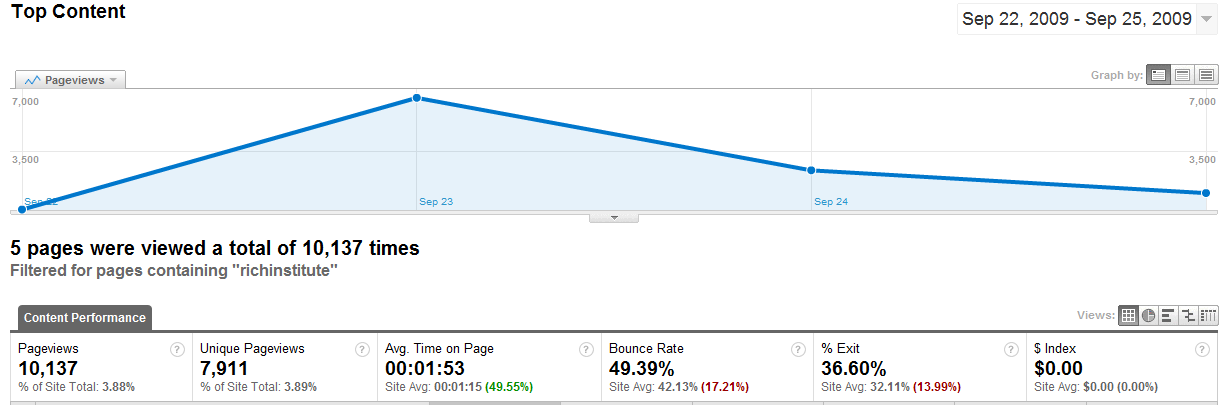
A second URL for the news release announcing the gift showed similar statistics. By comparison, 641 visitors viewed Marist Public Affairs news release pages yesterday.
That’s when I saw, first-hand, the power of social media, and I’ve been a proponent ever since.
There will be additional posts on social media down the line, but I would like to note an event held one week ago tonight. For junior communication major Marissa DeAngelis (@MSDe526), what started as a project for Professor Mark Van Dyke's (@markavandyke) public relations class turned into a learning opportunity for her and about three dozen Marist students, faculty, staff and local residents. Marissa, who is from Scituate, RI, organized a “TweetUp,” a gathering of twitter users connected to Marist who met face-to-face, many for the first time. It was also one of the first TweetUps on any college or university campus in the country.
Marissa, who will be in my COM470 class next semester, senior Alyssa Bronander of Wyckoff, NJ (@ARBro), who was in my class last semester, and junior Luke Shane of Bolton Landing, NY, (@LShane262 – who ran the Boston Marathon in 2:44:49 the day before and still had the energy to give a dynamic presentation at 9 p.m. Tuesday), all Communication majors, gave tips on how to best use social media. They detailed their forays into blogging and tweeting and the personal and professional connections they have made. Dean of Undergraduate Admission Kent Rinehart (the official @Marist tweeter) discussed how the college uses social media to communicate with current and prospective students and their families. I discussed the pros and cons of “digital footprints” and how they can help or hurt a student’s (or for that matter, anyone’s) search for employment.
Marissa’s organizational skills led to a well-run event. Alyssa will graduate in less than a month, and I can sum up her talents by a hashtag that some wise public relations agency, corporation or nonprofit will heed: #HireThisWoman!
Also in attendance was Chris Cornell (@cornell140), director of social media at Thompson & Bender, a Westchester-based public relations, advertising and marketing firm and the man behind TwitterProfessor.com. Chris also reported on the event for The Examiner, a weekly newspaper covering New York's Westchester and Putnam counties. The full article can be found at http://bit.ly/eMkkMJ.
Also in attendance was Chris Cornell (@cornell140), director of social media at Thompson & Bender, a Westchester-based public relations, advertising and marketing firm and the man behind TwitterProfessor.com. Chris also reported on the event for The Examiner, a weekly newspaper covering New York's Westchester and Putnam counties. The full article can be found at http://bit.ly/eMkkMJ.
One last thing...I’d like to thank Sarah Abouelmakarem (@Abouelmakarem), a Marist junior communications major with a concentration in public relations, for creating the banner at the top of this blog. Sarah used her artistic skills to develop the stained glass motif. We’re going to work on it just a little more, but her generous offer to give a visual identity to this blog was unsolicited and is greatly appreciated. Thank you again, Sarah.
Subscribe to:
Posts (Atom)